Free UK Mainland Shipping on Orders Over £25 (ex VAT)


Ultrasound Machines
(4)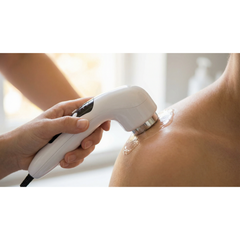
An ultrasound machine delivers high-frequency sound waves into soft tissue, warming and treating a specific area as you move the head over it. You keep the head moving so the heat spreads evenly and does not build up in one spot, which is central to using an ultrasound machine safely and comfortably. This gives you targeted, controllable treatment, which is why an ultrasound machine is used so widely in rehabilitation, sports therapy and everyday soft tissue care, at home and in clinics. Med-Fit's therapeutic ultrasound machine is the Med-Fit Pro 1 MHz Ultrasound Machine, a certified 1 MHz device built for deeper treatment across muscles, joints and larger soft tissue areas.
Most therapeutic ultrasound machines run at either 1 MHz or 3 MHz, and that frequency decides how deep the sound waves travel. It is the first thing to get right when choosing a machine. Other things that matter are portability, how easy the unit is to hold and move, the size and shape of the sound head, and whether gel and accessories are easy to restock.
What does an ultrasound machine do?
An ultrasound machine converts electrical energy into sound waves using a transducer built into the sound head, or probe. Inside that probe, piezoelectric crystals vibrate at high frequency and create sound waves above the range of human hearing. You spread ultrasound gel on the skin so those waves pass into the body, then move the head slowly and continuously over the area you are treating.
Moving the head matters. Holding it still lets heat concentrate in one place, so a steady, gliding motion spreads the energy evenly across the treatment area and keeps it comfortable. That control is the reason an ultrasound machine is a standard tool in soft tissue therapy and rehabilitation, and it is how the Med-Fit Pro 1 MHz is designed to be used.
How an ultrasound machine works
When the sound waves enter the tissue, they create rapid microscopic vibrations, and those vibrations produce two effects that make an ultrasound machine useful.
The first is heat. As the waves pass through the tissue, they warm it, and because a 1 MHz machine carries that energy deeper, the warming reaches below the surface as well as at it. Raising the local temperature supports blood flow and the movement of oxygen into the area, which is why ultrasound is so often linked with recovery and rehabilitation. The second is a mechanical effect, sometimes described with the terms cavitation and acoustic streaming. This is the movement the sound waves create in the tissue itself, working at a microscopic level even where heat is not the main goal.
Together, these are why an ultrasound machine is more than a warming device. It combines heat with mechanical action in a targeted, controllable way. The Med-Fit Pro 1 MHz delivers up to 6.4 watts across pulsed and continuous modes, so you can lean on whichever effect suits what you are treating.
Thermal and mechanical treatment modes
Most quality machines let you choose how the energy is delivered. Continuous mode runs the sound waves steadily and produces more heat, which suits warming tissue before movement or stretching. Pulsed mode delivers the energy in bursts, which limits how much heat builds up and puts more of the emphasis on the mechanical effect.
Having both modes on one ultrasound machine matters, because different problems call for different treatment. The Med-Fit Pro 1 MHz offers pulsed and continuous modes as standard, so you are not locked into one type of treatment.
1 MHz and 3 MHz ultrasound machines
The difference between a 1 MHz and a 3 MHz ultrasound machine is simple: 1 MHz waves travel deeper into the body, while 3 MHz waves are absorbed closer to the surface. This is one of the most common questions people have before buying, and it usually decides which machine is right.
A 1 MHz ultrasound machine suits larger muscle groups, joints, and deeper tendons and ligaments, because the energy is absorbed more gradually and reaches further in. That covers most of what people treat at home, from the lower back to the shoulders and knees. A 3 MHz machine is aimed at shallow structures just under the skin. Med-Fit's machine is 1 MHz, which is why it fits most home and rehabilitation use. For the full breakdown before you decide, read our guide to the difference between 1 MHz and 3 MHz ultrasound machines.
Why frequency matters when choosing an ultrasound machine
Frequency is the single biggest factor in whether an ultrasound machine suits your problem, and it counts for far more than headline power figures or how the unit looks. Choose the wrong depth and the treatment lands in the wrong place.
In practice, 1 MHz is the right starting point for deeper aches such as the lower back, larger muscles and joints, while 3 MHz is reserved for shallow, surface-level areas. Get the frequency right first and the rest of the decision becomes much easier. Deeper treatment is exactly what the Med-Fit Pro 1 MHz is built for.
Matching your ultrasound machine to the treatment area
A useful way to choose is to match the frequency to how deep the problem sits. Deeper targets such as the lower back, thighs, calves, shoulders and knees suit a 1 MHz ultrasound machine. Areas right under the skin are more superficial and lean towards 3 MHz.
This also answers one of the most common questions people search for, which is whether a given machine will work on a specific part of the body. Choose on penetration depth rather than output claims or appearance. If back pain is your main reason for buying, our guide to using an ultrasound machine for back pain shows how 1 MHz is applied.
What can you treat with an ultrasound machine?
An ultrasound machine is used across a wide range of muscle, joint and soft tissue problems. Because the Med-Fit Pro 1 MHz reaches deeper structures, it covers most of the complaints people treat at home, including:
- Neck and chronic back pain, where deeper muscle and joint tissue is involved
- Osteoarthritis and general joint pain, to support movement and recovery
- Tendinitis, including tennis elbow and golfer's elbow
- Muscle strains and ligament sprains from sport or everyday injury
- Plantar fasciitis and other stubborn soft tissue pain
- Scar tissue and bruising, as part of a wider